
Lenten Fasting and Communion

Now that we have embarked on our Lenten fasts and penances, hopefully we are continuing to thoughtfully consider how and why we are practicing them. Lent isn’t just the time of year to once again give up chocolate or snacking. Reading more scripture and getting to Mass more regularly are good practices, but Lent isn’t just about that either. Lent is the season to empty ourselves, even of apparent goods, to make room for the greatest good, God. We cannot fill ourselves more completely with the Holy Spirit unless we first empty ourselves and let go of thoughts and practices that divert our attention from Him. Ultimately, we fast, pray, and give alms not for ourselves or anything we hope to gain, but rather so that we can encounter God more intimately. And when we do, when we call on Him, we trust He will be ever closer and more present to us.

Isaiah tells us God is displeased with His people, because they fast in an attempt to gain His favor. They “abandon the law” (58:2) and then demand God’s attention. They make a show of their penance and are irritated when God seems to ignore them. “Why do we fast,” they cry, “and you do not see it? Afflict ourselves, and you take no note of it” (58:3)?

God is angry because He understands the people’s intentions. They are not being selfless; they are “quarreling and fighting” (Is 58:4). “You carry out your own pursuits” (Is 58:3), God declares, in ways that are prideful and vainglorious.

God then tells us what he desires. The “fasting that I wish” (Is 58:6), He explains, is based not on what we give up or how hungry we look or how hard we’re trying. Rather, God wishes for us to sacrifice by serving others. We are to treat people justly, “free the oppressed,” feed the hungry, “shelter the homeless,” and “clothe the naked,” so as to ultimately “not [turn] your back on your own” (Is 58:7).

God desires our service, sacrifice, and emptying of ourselves for others. This is what draws us to Him; this is what He will reward. God tells us when we are rightly ordered in our sacrifice, when we are merciful to others, He will come to our assistance. Our “light shall break forth” (Is 58:8). Our “wound shall be quickly healed” (Is 58:8). We shall be “vindicated,” and the Lord will protect us and shore our efforts with His “glory” (Is 58:8).

This, then, is the invitation of Lent. In our emptying and sacrificing and serving, we are making room not only for a more intimate encounter with God, but also charitable encounters with our brothers and sisters along the way. As Sister Miriam James Heidland tells us, “The whole of the Lenten journey is [ordered towards] communion” (WOF, Refusal to Grasp). It is our willingness to see Christ in the other and to be Christ to him that draws us to the heart of the Father. And this, after all, is what St. Augustine tells us our restless hearts most desire–to rest in Him.

May we discover God’s mercy and consolation this Lent, trusting that our fasts and sacrifices will be met with His scandalously abundant gratuitous love. It should be the greatest desire of our hearts, worn and bruised and stretched wide open, to hear Him say to us, “Then you shall call, and the LORD will answer, you shall cry for help, and he will say: Here I am!” (Is 58:9).
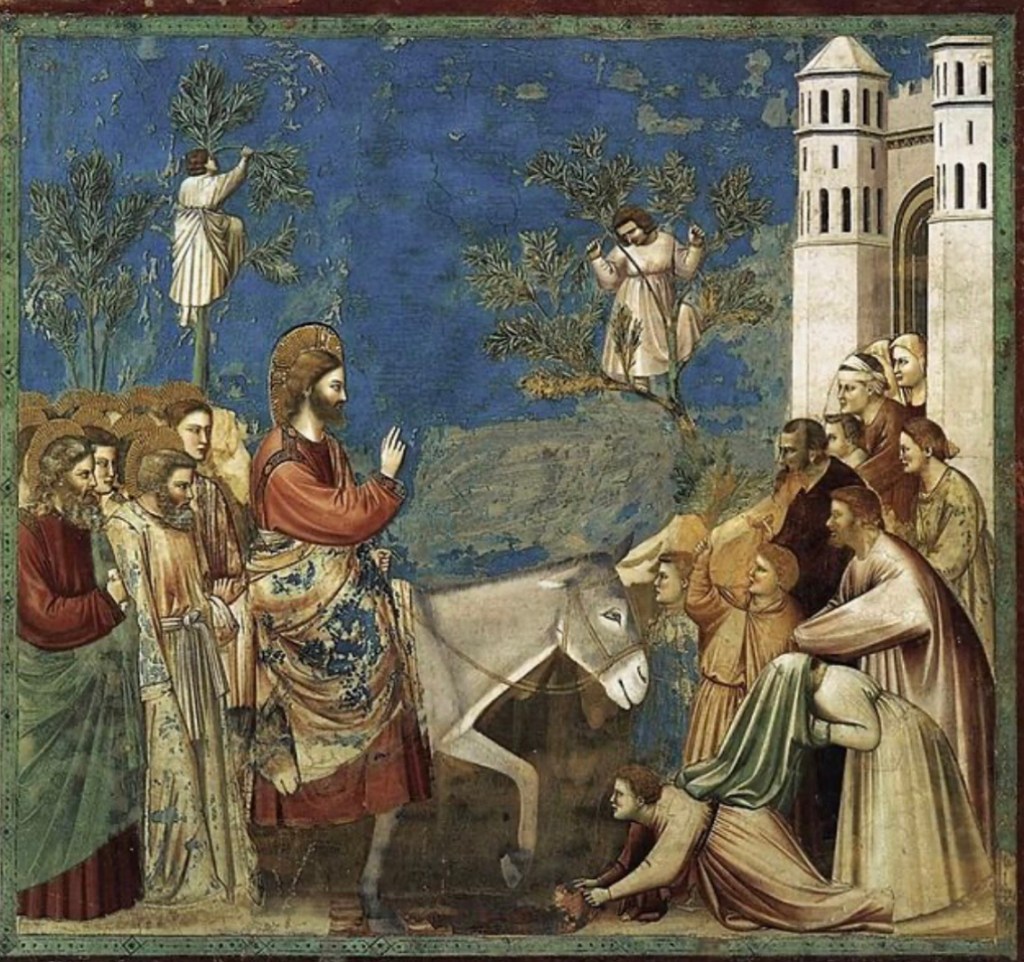
They Did Not Understand

The Entry Into Jerusalem, Giotto, c. 1300

On the sixth Sunday of Lent, as we prepare for the days in the desert to end and we embark on the Triduum, leading to Easter, John tells us of Jesus’s entry into Jerusalem. He describes how the crowd goes out to meet Jesus, celebrating Him with palm branches and singing, “Hosanna!” John further reports how the disciples “did not understand this at first” (Jn 12:16). Despite their years with the Lord, they did not correlate what they were witnessing with what they learned in the Old Testament: “See, your king shall come to you; a just savior is he, Meek, and riding on an ass, on a colt, the foal of an ass” (Zech 9:9).

In his commentary on the Godsplaining podcast, Father Joseph-Anthony Kress discusses this event and how relevant it is to us today. Father observes how relatable the disciples are to us. Even these men who knew Jesus, who understood Him and loved Him, didn’t fully understand that the Lord’s entry into Jerusalem, while representing that of a king, would also lead to his great and brutal sacrifice.

Father reminds us that we are often like the disciples. God breaks into our lives, allows struggles, and reveals our weaknesses, and even though we trust in Him, we don’t understand how He is working. We witness and watch and pray, but just what is happening to us and why remain mysteries. Because we are faithful, however, because we believe in His great glory, we follow the Lord.

As we enter into this most holy time of the year, may we continue to watch and wait for God to reveal Himself to us. May we be ever obedient and attentive to His voice, to how He is moving in our hearts, so that not only may we unite our sufferings and perpetual deaths with Him, but also so that we might be resurrected with the glorified Lord at Easter.

The following is an exerpt from Father Joseph-Anthony Kress’s commentary:

“The concluding lines of this Gospel show that His disciples did not understand what was happening. They didn’t understand it at first. When we hear that, we think…they didn’t realize what he was doing, but once it all started, they got it, they got it. It says here they didn’t understand it until after He was glorified. ‘His disciples did not understand this at first, but when Jesus had been glorified they remembered that these things were written about him and that they had done this for him’ (Jn 12:16). 

I can picture His disciples when He gets on that colt; people are waving their palm branches and singing, “Hosanna!” [but] they’re still baffled at what was happening. It’s not like they were able to lean into it and [understand]. You can still see them following Jesus in confusion. They didn’t fully understand everything until His glory. I feel a lot of comfort and encouragement [from this]. There are many times I continue to follow Jesus and I’m just confused. I can’t make sense of these things and yet, I still find myself following Jesus—maybe at times joining in with the crowds and crying out Hosanna and maybe sometimes falling short.

Even His disciples in these really key moments of His final approach into Jerusalem moving into the Passion narrative…had no idea what was happening. [Like them we] we might be afraid and confused…[and] there are times when we don’t understand and maybe we’re baffled. But we continue to follow Jesus and our faith just like His disciples did because we’re confident in the glory that awaits us. In that glory of the Lord, we too, will understand the things that happened. In His Providence we will be able to see with unveiled faces.”

https://youtu.be/VNBtlYXBg5M?si=M1Q_1LiczEgbYngC

Friar Wisdom, Fifth Sunday of Lent

Rembrandt, Christ Preaching, c. 1652

On Sunday, March 17, 2024, on their Godsplaining podcast, Fathers Gregory Pine, O.P., Patrick Briscoe, O.P., and Joseph-Anthony Kress, O.P., discussed in Lectio format the readings for the Fifth Sunday of Lent. The following is a transcript of Father Kress’s comments regarding the Gospel reading from John 12:20-33. (The full episode appears below.) Here Father inspiringly discusses how God not only reveals the Paschal Mystery to us in the life and Passion of Jesus, but how we are called to participate in this Mystery as well. By uniting ourselves with Christ’s suffering, we enter into an ever-deepening relationship with Jesus and the Father–one that is continually nourished and renewed by the outpouring and receiving of love that can only come from God.

The Lord’s gives Himself totally in His willingness to enter into this mystery—[the Paschal Mystery]. Our lives need to have elements of [this], if not totally imitate [this] full union of sacrifice with the Lord. Using the image of the seed falling to the ground in order to die to bring forth that new life, the Lord is [saying] destruction isn’t the final answer. It [death] doesn’t have the final word. Destruction and death aren’t terminal. There is going to be new life from this. It seems poetic and romanticized, but He says, “No, no. Look around you in nature. This has always been my plan. Always. New life comes from death. It doesn’t have the final word.” 

I go back to the words, “Then a voice came from heaven” (Jn 12:28). “The crowd heard it and said it was thunder” (Jn 12:29), then others called it an angel. It was the voice of the Father, who said, “I have glorified it and will glorify it again” (Jn 12:28). I’ve done it. And I’ll do it again. That phrase, “I will glorify it again.” How is the Father’s name repeatedly glorified? It’s by each and every one of us uniting in our sufferings and our deaths in this life to the death of His son. He has glorified His name by revealing His Son to us and allowing His Son to redeem us. That did happen. He did that. He has glorified His name in His Son, Jesus Christ. And He will do it again and continues to be glorified with each and every one of us, uniting us—our lives, our sufferings—to the Cross of Jesus Christ. [God] ultimately unites our deaths to [Jesus’s] death in order to bring forth resurrection. So that promise, that is a promise from the voice of the Father that [He] will glorify again. It’s our repeated glorification of the Father in His name by our union with Jesus in His life, death, and resurrection into the Paschal Mysteries.