Living the Beatitudes and Remembering Charlie Kirk

“Raising His eyes toward His disciples Jesus said: ‘Blessed are you who are poor, for the Kingdom of God is yours. Blessed are you who are now hungry, for you will be satisfied. Blessed are you who are now weeping, for you will laugh. Blessed are you when people hate you, and when they exclude and insult you, and denounce your name as evil on account of the Son of Man….But woe to you who are rich, for you have received your consolation. But woe to you who are filled now, for you will be hungry. Woe to you who laugh now, for you will grieve and weep. Woe to you when all speak well of you, for their ancestors treated the false prophets in this way'” (Luke 6:20-26).

Because I don’t believe in coincidences, but rather in Providence, it is not surprising that this gospel from Luke is the today’s reading on the day that Charlie Kirk was assassinated. With his shocking murder in mind, I am inspired to reflect on this passage in a broader, more immediate way.

As is often the case, Jesus shocks us with His language which invites us to see reality and the spiritual life with a new perspective. He tells us we are blessed if we are “poor,” “hungry,” “weeping,” “hated,” “excluded and insulted,” and “denounced” for believing in Him. How can this be? Jesus’ words are shocking, considering most of us understandably wish and actually work to reject all of this. Our culture tells us we are to strive for success, fulfillment, happiness, love, and inclusion at any cost. How can we want the opposite? Furthermore, how are we blessed by all this suffering?

But Jesus doesn’t stop there. He goes further. Not only are we to suffer, but He also tells us “woe” to those who are “full,” who “laugh,” and are admired. Isn’t this what life is about? Happiness, fulfillment, getting what we want?

On the contrary, Jesus tells us when we are poor and needy, we are to “rejoice and leap for joy,” for our “reward will be great in heaven.”

Why does Jesus focus on our suffering here? Why are we to be poor and small and needy? He tells us this, because if we are filled with the riches of this world, if we are consumed with what we can get and do and have, we will become self-sufficient; we will have little need for Him. He is the way. Only in Him can we find meaning and love and rest for our restless hearts, as Augustine tells us.

Charlie Kirk was successful and much loved by many, but he was also hated–hated so much that he lost his life for standing for Truth. But those of us committed to Truth, to life, to freedom, know Charlie embodied the courage and perseverance we are all called to cultivate as Christians. Perhaps this consolation feels meagre at this moment, on the evening of his death, but we can be sure that Charlie died a martyr for God, Truth, honesty, and the American Way. Let us pray that he is indeed rejoicing and leaping for joy and that that his reward is great in heaven.

Rest in Peace, Charlie Kirk.

Jesus Heals Through His Humanity

During the month of July, Catholics celebrate the Precious Blood of Jesus. We are invited to contemplate our Lord’s sacrifice—literally the pouring out of His life force for all of humanity itself. It seems timely, then, that on the eve of this devotional time in the Church, we read from Mark about Jesus’s encounter with Jarius and the woman suffering from a hemorrhage. Why timely? Because this story, which in its graceful arc intricately and artfully entwines two distinct and co-equal plots, highlights our Lord’s humanity. Yes, it is His divinity that miraculously heals. But it is Jesus’s willingness and desire to physically and emotionally encounter the other in his and her humanness that ultimately invite and allow for physical and spiritual restoration.

In Mark 5:21-43, the narrative is shaped and informed by physicality. The crowds are loud and chaotic as they press on and push against Jesus, and even the private moments are characterized by tender physical intimacy. Integral to Jesus’s humanity is His attentive listening. This “human skill,” this “fruit” that defines Christ’s “path,” becomes and forms the path of the story itself (Spiritual Direction Certificate Program, 2019, p. 1).

Jairus appears, begging Jesus to heal his dying daughter. Jesus immediately answers this call into relationship with him, “leaving [Himself] behind…[and] entering fully into [Jairus’s] narrative” (Spiritual Direction, et. al., 2019, p. 1). The woman is introduced amidst this chaos, and the story shifts. Faithful despite her suffering, she is drawn to Jesus’s humanity. He is moving away from her, mobbed by followers, but she pursues Him, believing, “If I but touch his clothes, I will be made well” (5:28). As soon as she touches Jesus, He not only enters her reality, into relationship with her, He “becomes” her reality. “Immediately her hemorrhage stopped,” and Jesus was “[i]mmediately aware that power had gone forth from Him” (5:29-30). What’s more, to the incredulity of His disciples, He asks who touched Him. Jesus questions not only to “listen to others,” but also to form relationships with them—“to hear and explore what is on the other’s heart and mind” (Spiritual Direction, et. al., 2019, p. 1). The woman, knowing “in her body that she was healed” (5:29), could have quickly exited, but Jesus calls her to Him, her former unclean “qualities fad[ing] into…insignificance” (Van Kaam, 1996, p. 19). 

It is also significant that the woman’s hemorrhaging blood simultaneously represents the essence of her societal “uncleanliness” as well as the life force that had been draining from her for years and causing her terrible suffering. Both her status as an outcast and a woman in constant pain results in her separateness from others—physically, emotionally, and spiritually. It is in Jesus’s vibrant humanity, however, that He stops the purging of this life force, returning not only her body but also, because of her faith, her spirit to right order.

While Jesus is still speaking to the woman, we are suddenly thrust back into the clamoring crowd. People are telling Jairus the girl is already dead. Hearing or ignoring this, Jesus comforts him “with reassurances of His love” (Acklin & Hicks, 2017, p. 52). Taking only Jairus, Peter, James, and John with Him, Jesus is again immersed in suffering: “weeping and wailing” at the girl’s house. He invites the family to believe the child only sleeps, but they reject this offer of faith, laughing at Him instead. Jesus’s rises up in the strength and tenderness of His humanity, sending them away, and moving towards the girl, into the sanctum of her room (of her being). His actions say, “[L]et me concentrate on giving you my entire attention” (Sullivan, 2000, p. 126), and He calls her into relationship with Him, commanding, “Talitha Cum” (5:41). This healing, unlike that of the woman, is intensely private; Jesus instructs the parents to tell no one. His humanity is delightfully lastly revealed when He pragmatically tells the girl’s parents to “give her something to eat” (5:43). Like her soul, her body requires nourishment, as well.

These stories prompt us to ask, When we suffer, will we have Jairus’s courage to beg for Jesus’s help? When we experience severe emotional and physical pain, will we persevere as the outcast woman, crawling through the crowd to touch Jesus’s garment? Let us pray that indeed we will. As our faith deepens, may we understand that the “human encounter” with Jesus is “the essence of cure in the deepest sense,” and that He calls us to Him through the fortitude of faith (Van Kaam, 1996, pp. 19-20).

Acklin, T., & Hicks, B. (2017). Vulnerability. In Spiritual Direction: A Guide for Sharing the Father’s Love (pp. 49-74). Emmaus Road Publishing.

Spiritual Direction Certificate Program (2019). What Does It Mean To Listen? (p. 1). Unpublished. 

Sullivan, J.E. (2000). The Healing Power. In The Good Listener (pp. 124-128). Ave Maria Press.

Van Kaam, A. (1996). Counseling and Psychotherapy as Human Encounter. In The Art of Existential Healing (pp. 15-40). Dimension Books.

They Did Not Understand

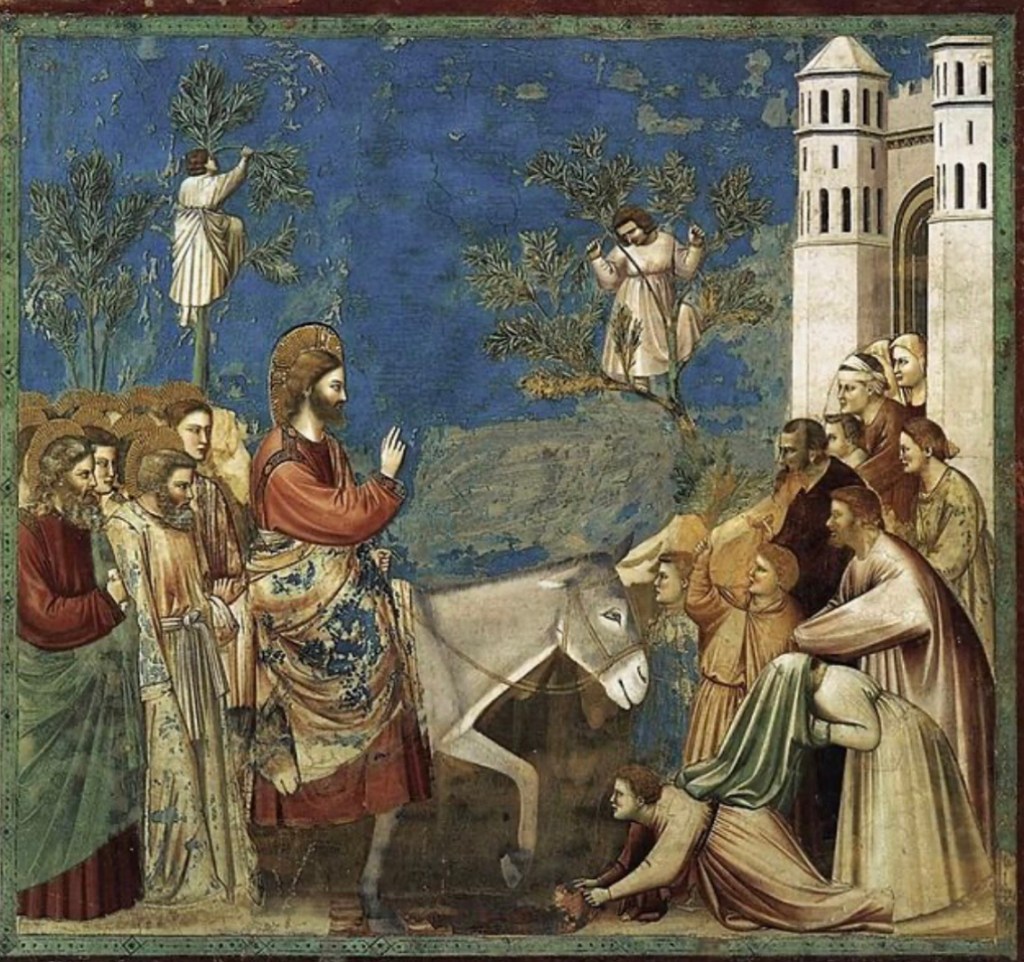
The Entry Into Jerusalem, Giotto, c. 1300

On the sixth Sunday of Lent, as we prepare for the days in the desert to end and we embark on the Triduum, leading to Easter, John tells us of Jesus’s entry into Jerusalem. He describes how the crowd goes out to meet Jesus, celebrating Him with palm branches and singing, “Hosanna!” John further reports how the disciples “did not understand this at first” (Jn 12:16). Despite their years with the Lord, they did not correlate what they were witnessing with what they learned in the Old Testament: “See, your king shall come to you; a just savior is he, Meek, and riding on an ass, on a colt, the foal of an ass” (Zech 9:9).

In his commentary on the Godsplaining podcast, Father Joseph-Anthony Kress discusses this event and how relevant it is to us today. Father observes how relatable the disciples are to us. Even these men who knew Jesus, who understood Him and loved Him, didn’t fully understand that the Lord’s entry into Jerusalem, while representing that of a king, would also lead to his great and brutal sacrifice.

Father reminds us that we are often like the disciples. God breaks into our lives, allows struggles, and reveals our weaknesses, and even though we trust in Him, we don’t understand how He is working. We witness and watch and pray, but just what is happening to us and why remain mysteries. Because we are faithful, however, because we believe in His great glory, we follow the Lord.

As we enter into this most holy time of the year, may we continue to watch and wait for God to reveal Himself to us. May we be ever obedient and attentive to His voice, to how He is moving in our hearts, so that not only may we unite our sufferings and perpetual deaths with Him, but also so that we might be resurrected with the glorified Lord at Easter.

The following is an exerpt from Father Joseph-Anthony Kress’s commentary:

“The concluding lines of this Gospel show that His disciples did not understand what was happening. They didn’t understand it at first. When we hear that, we think…they didn’t realize what he was doing, but once it all started, they got it, they got it. It says here they didn’t understand it until after He was glorified. ‘His disciples did not understand this at first, but when Jesus had been glorified they remembered that these things were written about him and that they had done this for him’ (Jn 12:16). 

I can picture His disciples when He gets on that colt; people are waving their palm branches and singing, “Hosanna!” [but] they’re still baffled at what was happening. It’s not like they were able to lean into it and [understand]. You can still see them following Jesus in confusion. They didn’t fully understand everything until His glory. I feel a lot of comfort and encouragement [from this]. There are many times I continue to follow Jesus and I’m just confused. I can’t make sense of these things and yet, I still find myself following Jesus—maybe at times joining in with the crowds and crying out Hosanna and maybe sometimes falling short.

Even His disciples in these really key moments of His final approach into Jerusalem moving into the Passion narrative…had no idea what was happening. [Like them we] we might be afraid and confused…[and] there are times when we don’t understand and maybe we’re baffled. But we continue to follow Jesus and our faith just like His disciples did because we’re confident in the glory that awaits us. In that glory of the Lord, we too, will understand the things that happened. In His Providence we will be able to see with unveiled faces.”

https://youtu.be/VNBtlYXBg5M?si=M1Q_1LiczEgbYngC

Friar Wisdom, Fifth Sunday of Lent

Rembrandt, Christ Preaching, c. 1652

On Sunday, March 17, 2024, on their Godsplaining podcast, Fathers Gregory Pine, O.P., Patrick Briscoe, O.P., and Joseph-Anthony Kress, O.P., discussed in Lectio format the readings for the Fifth Sunday of Lent. The following is a transcript of Father Kress’s comments regarding the Gospel reading from John 12:20-33. (The full episode appears below.) Here Father inspiringly discusses how God not only reveals the Paschal Mystery to us in the life and Passion of Jesus, but how we are called to participate in this Mystery as well. By uniting ourselves with Christ’s suffering, we enter into an ever-deepening relationship with Jesus and the Father–one that is continually nourished and renewed by the outpouring and receiving of love that can only come from God.

The Lord’s gives Himself totally in His willingness to enter into this mystery—[the Paschal Mystery]. Our lives need to have elements of [this], if not totally imitate [this] full union of sacrifice with the Lord. Using the image of the seed falling to the ground in order to die to bring forth that new life, the Lord is [saying] destruction isn’t the final answer. It [death] doesn’t have the final word. Destruction and death aren’t terminal. There is going to be new life from this. It seems poetic and romanticized, but He says, “No, no. Look around you in nature. This has always been my plan. Always. New life comes from death. It doesn’t have the final word.” 

I go back to the words, “Then a voice came from heaven” (Jn 12:28). “The crowd heard it and said it was thunder” (Jn 12:29), then others called it an angel. It was the voice of the Father, who said, “I have glorified it and will glorify it again” (Jn 12:28). I’ve done it. And I’ll do it again. That phrase, “I will glorify it again.” How is the Father’s name repeatedly glorified? It’s by each and every one of us uniting in our sufferings and our deaths in this life to the death of His son. He has glorified His name by revealing His Son to us and allowing His Son to redeem us. That did happen. He did that. He has glorified His name in His Son, Jesus Christ. And He will do it again and continues to be glorified with each and every one of us, uniting us—our lives, our sufferings—to the Cross of Jesus Christ. [God] ultimately unites our deaths to [Jesus’s] death in order to bring forth resurrection. So that promise, that is a promise from the voice of the Father that [He] will glorify again. It’s our repeated glorification of the Father in His name by our union with Jesus in His life, death, and resurrection into the Paschal Mysteries. 

Living in Right Order as a Family

“Brothers and sisters: Put on, as God’s chosen ones, holy and beloved, heartfelt compassion, kindness, humility, gentleness, and patience, bearing with one another and forgiving one another, if one has had grievance against another; as the Lord has forgiven you, so must you also do. And over all these put on love, that is, the bond of perfection. And let the peace of Christ control your hearts, the peace into which you were also called in one body. And be thankful. Let the word of Christ dwell in you richly, as in all wisdom you teach and admonish one another, singing psalms, hymns, and spiritual songs with gratitude in your hearts to God. And whatever you do, in word or in deed, do everything in the name of the Lord Jesus, giving thanks to God the Father through him. Wives, be subordinate to your husbands, as is proper in the Lord. Husbands, love your wives, and avoid any bitterness toward them. Children, obey your parents in everything, for this is pleasing to the Lord. Fathers, do not provoke your children, so they may not become discouraged” (2 Col 3:12-21).

Today we celebrate the Feast of the Holy Family. We are called to look to Jesus, Mary, and Joseph, each holy and perfected, as the example of how to lead our lives in community devoted to God. In addition to the Holy Family, today’s Second Reading presents instructions for how to live with others in right order. With Christ at the center of all we do, we are to be compassionate, kind, humble, gentle, patient, and forgiving. We are to be thankful and lovingly correct one another. We are to honor the natural hierarchical order of the family. Rather than an arena of power struggles and contentiousness, this order, based on mutual respect and love, promotes encouragement, freedom, and the love of God.

At a time when the family is under attack; when chaos undermines the very foundation of male and female; and when the culture actively seeks to destroy life, taint childhood, and turn parents and children against one another, we are called to turn to the Holy Family for guidance and reassurance. Before Sister Lucia dos Santos, one of the three children of Fatima, died, she declared that the final battle between Christ and Satan would be over marriage and family. “The final battle between the Lord and the kingdom of Satan,” she wrote, “will be about marriage and the family.” She added, however, that “Our Lady has already crushed Satan’s head.”

As individuals as well as members of families and communities, let us look to Jesus, Mary, and Joseph. Regardless of what the culture tells us, let us remain faithful to their example of communal holiness, connected through faith and devotion to God and who he calls us to be.

We are the Woman of Tyre

Jesus went to the district of Tyre. He entered a house and wanted no one to know about it, but he could not escape notice. Soon a woman whose daughter had an unclean spirit heard about him. She came and fell at his feet. The woman was a Greek, a Syrophoenician by birth, and she begged him to drive the demon out of her daughter. He said to her, “Let the children be fed first. For it is not right to take the food of the children and throw it to the dogs.” She replied and said to him, “Lord, even the dogs under the table eat the children’s scraps.” Then he said to her, “For saying this, you may go. The demon has gone out of your daughter.” When the woman went home, she found the child lying in bed and the demon gone (Mark 7:24-30).

When I read this Gospel early yesterday morning (2/9/23), it immediately resonated with me in a deep way, and I smiled to myself, understanding that God was speaking to my heart. 

Here is the Lord, wanting some time away from the crowds during His full days of ministering to them. In His humanity, we can imagine He is tired; He has been talking and healing for hours. But alas, this is not to be. A woman, a Gentile, no less, has found Jesus, followed Him into the house, and then falls “at His feet.” 

At first, He is noticeably a little irritated (although probably just responding in a clarifying manner) and tries to dismiss her. Jesus makes a comment about children and dogs, which scholars have argued has a variety of meanings, but ultimately suggests that He is at least appearing to be reluctant to help her. The woman, however, understanding His meaning, persists. Her love for her daughter is so great, her willingness to confront the Lord is so courageous and faithful, that Jesus cannot deny her. Even in this brief encounter, she and Jesus have formed a relationship—one of trust and love and faith. Jesus bears witness to the woman’s very real vulnerability, understands and hears her, and because of this frees her daughter from sin. 

How many times have we suffered for our children? How many hours have we worried, sought answers, and committed ourselves to doing anything we can to alleviate their suffering, pain, and struggle? How many late nights and early mornings have we sat in prayer, asking the Lord to deliver them? 

This mother in this story represents every one of us who has found the courage to become righteous warriors for our children—every one of us who is willing to go to the Lord, pleading for His merciful goodness and healing. It is not enough, however, just to ask for God’s help. Like this woman, we must remain determined to seek Him, follow Him, and then speak to Him with hearts fully open to His love. We cannot do this haphazardly. We cannot neglect Jesus for long periods of time and then only go to Him when we’re desperate. Of course, God can attend to us at any time. Even when we’ve been away from Him for a while, we can experience the healing of actual grace. But what this mother shows us is that when we are in relationship with Christ, when we are determined to find Him, be near Him, and ask for His understanding and help, He will always answer us. 

Although in this story Jesus was seeking time away from the crowds, He actually wants us to look for and find Him. In fact it is our very suffering that serves to draw us close to Him. He knows this, which is why, when we call for Him in our pain, He is there to comfort and heal us. 

At a time in our culture when women and mothers are often undermined and questioned, and when we sometimes ask ourselves if we have the courage to help our children through their sufferings, let this woman assure us we are in fact capable of doing just that. We cannot do it alone, however. As we cultivate our relationship with God, as we sit at the foot of the cross and integrate our pain with Jesus’s sacrifice, we are then in a position to best serve, care for, and lead our children. 

Mirroring the humility and faith of this woman and of course, Our Lady, may we continue to seek God’s love and goodness. May we pursue Him with courage and fierceness. And may we know when He answers us that it is our faith, born out of the crucible of suffering, that has saved us.