Called to Humility

The Catechism tells us, “‘Prayer is the raising of one’s mind and heart to God or the requesting of good things from God.’ But when we pray, do we speak from the height of our pride and will, or ‘out of the depths’ of a humble and contrite heart? He who humbles himself will be exalted; humility is the foundation of prayer. Only when we humbly acknowledge that ‘we do not know how to pray as we ought,’ are we ready to receive freely the gift of prayer. ‘Man is a beggar before God'” (CCC 2559).

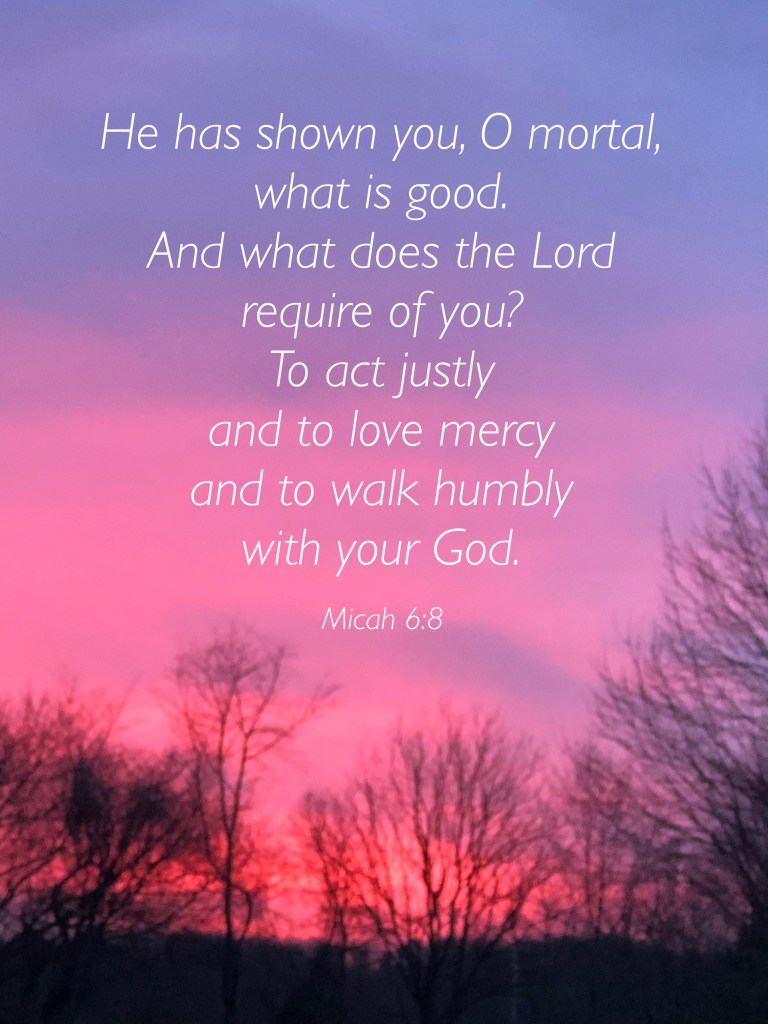
If we are called to humility in prayer, Micah’s words speak to how we are to “be” in the world. Yes, we carry our prayers with us throughout the day. We are called to “pray without ceasing” (1 Thessalonians 5:17). But notice how Micah addresses us as “mortals.” As “good” people, what is “required” of us in the world? Who are we called to be with each other? After all, Jesus desires to have a “real” relationship with us, and it is this union that is meant to inform all of our other relationships. We care called to “act,” “love,” and “walk”–all physical, real life experiences, imbued with the virtues of justice, mercy, and humility.

And who is at the center of this very being? This mortal experience? God, of course, “For in Him we live, and move, and have our being” (Acts 17:28).

Do You Know Who You Are? Some Initial Thoughts on the Theology of the Body

Do you know who you are? No, I’m not asking your name, what you do for a living, or if you play a sport. I’m asking, Do you actually KNOW WHO YOU ARE?

Today we are told our identities are fluid, changeable. We are told our sex is not only “assigned” at birth, but also that our sex (the physical bodily expression of maleness or femaleness) is only a servant to our more “important” gender–how we self-express and see ourselves in society. In other words, we are told our gender (how we self-express) is to comply with how we feel, rather than aligning how we feel (which can change depending on our state of mind or mood) with the reality of the body, which is our “sex.”

At the root of all of this confusion is our disrupted relationship with God and with the Holy Spirit who lovingly calls us into right order with Him. As our culture increasingly rejects Him, we become more confused and willing to accept the dystopia and dysphoria that result from this separation. As Gaudium et Spes declared, “When God is forgotten, the creature itself grows unintelligible” (36). Commenting on this idea, Jason Evert explains in Ascension’s course on Theology of the Body, “When we lose sight of supernatural realities, we will lose sight of natural realities” (Segment 2, Session 1). Indeed, we have lost sight of the reality of who we are, not only physically (we reject our very bodies), but also spiritually–who we are in God.

Here are some additional excerpts to ponder from Jason’s presentation:

“Our bodies reveal not only our identity as male and female, but also our calling.” Who we are is determined by our bodies, and it is this identity that calls us into relationship with one another in a unique and ordered way. When we don’t know who we are as male and female, our relationships with ourselves and each other become disordered.

“Men and women make the invisible love of God visible on earth by the way we love.” Although God is invisible, He is made visible, made manifest, through our very bodies and the way we love one another. We are called to reflect the perfect love of the Trinity. God’s relationship with the Son is expressed through the Holy Spirit, who is the unending and ever-moving love between them.

Today we are encouraged to identify with our concupiscence; we are encouraged to declare, “God made me this way, so I’m fine as I am.” But this is not who we really are. “If I come to think that my brokenness is who I am and who God wants me to be, then I’m normalizing my brokenness. And we will assume the Church is out of touch with reality if it expects us to live differently.” But JP II has a different vision. He declares that “our brokenness is not who God created us to be…These vices do not [constitute] our identities. We are not the sum of our weaknesses and failures.”

What is your identity? How are you defining it? Do you know who you are?

We are the Woman of Tyre

Jesus went to the district of Tyre. He entered a house and wanted no one to know about it, but he could not escape notice. Soon a woman whose daughter had an unclean spirit heard about him. She came and fell at his feet. The woman was a Greek, a Syrophoenician by birth, and she begged him to drive the demon out of her daughter. He said to her, “Let the children be fed first. For it is not right to take the food of the children and throw it to the dogs.” She replied and said to him, “Lord, even the dogs under the table eat the children’s scraps.” Then he said to her, “For saying this, you may go. The demon has gone out of your daughter.” When the woman went home, she found the child lying in bed and the demon gone (Mark 7:24-30).

When I read this Gospel early yesterday morning (2/9/23), it immediately resonated with me in a deep way, and I smiled to myself, understanding that God was speaking to my heart. 

Here is the Lord, wanting some time away from the crowds during His full days of ministering to them. In His humanity, we can imagine He is tired; He has been talking and healing for hours. But alas, this is not to be. A woman, a Gentile, no less, has found Jesus, followed Him into the house, and then falls “at His feet.” 

At first, He is noticeably a little irritated (although probably just responding in a clarifying manner) and tries to dismiss her. Jesus makes a comment about children and dogs, which scholars have argued has a variety of meanings, but ultimately suggests that He is at least appearing to be reluctant to help her. The woman, however, understanding His meaning, persists. Her love for her daughter is so great, her willingness to confront the Lord is so courageous and faithful, that Jesus cannot deny her. Even in this brief encounter, she and Jesus have formed a relationship—one of trust and love and faith. Jesus bears witness to the woman’s very real vulnerability, understands and hears her, and because of this frees her daughter from sin. 

How many times have we suffered for our children? How many hours have we worried, sought answers, and committed ourselves to doing anything we can to alleviate their suffering, pain, and struggle? How many late nights and early mornings have we sat in prayer, asking the Lord to deliver them? 

This mother in this story represents every one of us who has found the courage to become righteous warriors for our children—every one of us who is willing to go to the Lord, pleading for His merciful goodness and healing. It is not enough, however, just to ask for God’s help. Like this woman, we must remain determined to seek Him, follow Him, and then speak to Him with hearts fully open to His love. We cannot do this haphazardly. We cannot neglect Jesus for long periods of time and then only go to Him when we’re desperate. Of course, God can attend to us at any time. Even when we’ve been away from Him for a while, we can experience the healing of actual grace. But what this mother shows us is that when we are in relationship with Christ, when we are determined to find Him, be near Him, and ask for His understanding and help, He will always answer us. 

Although in this story Jesus was seeking time away from the crowds, He actually wants us to look for and find Him. In fact it is our very suffering that serves to draw us close to Him. He knows this, which is why, when we call for Him in our pain, He is there to comfort and heal us. 

At a time in our culture when women and mothers are often undermined and questioned, and when we sometimes ask ourselves if we have the courage to help our children through their sufferings, let this woman assure us we are in fact capable of doing just that. We cannot do it alone, however. As we cultivate our relationship with God, as we sit at the foot of the cross and integrate our pain with Jesus’s sacrifice, we are then in a position to best serve, care for, and lead our children. 

Mirroring the humility and faith of this woman and of course, Our Lady, may we continue to seek God’s love and goodness. May we pursue Him with courage and fierceness. And may we know when He answers us that it is our faith, born out of the crucible of suffering, that has saved us.

The Day After Christmas

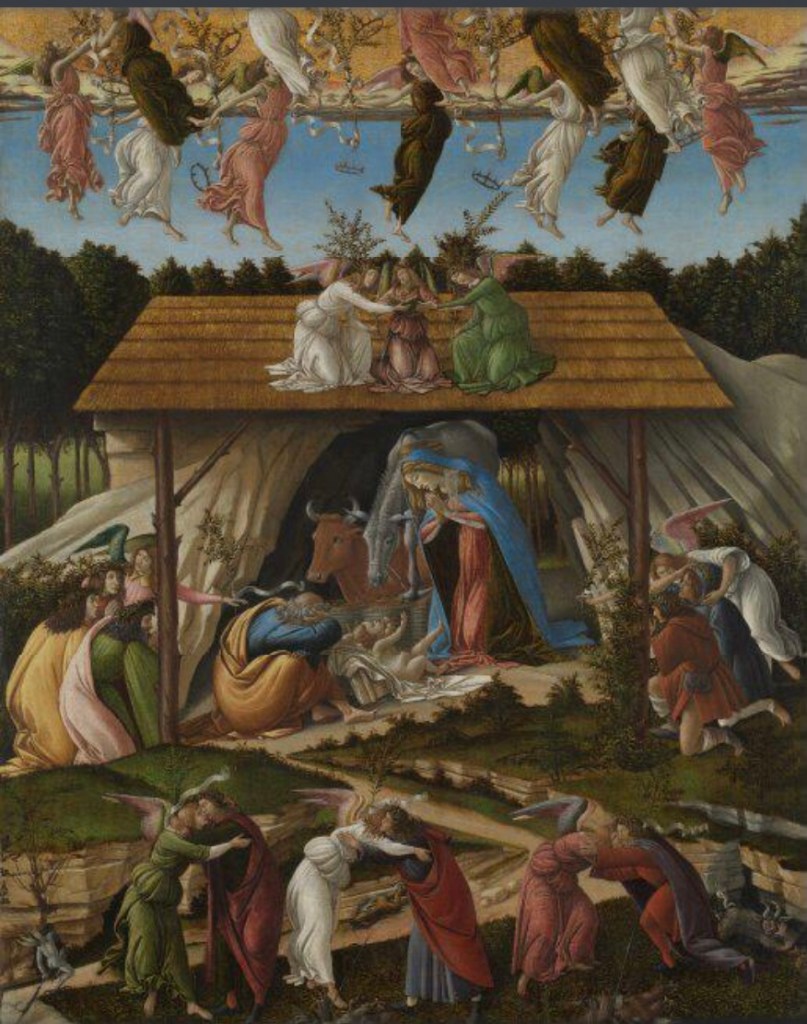
Botticelli, Mystic Nativity, 1500, National Gallery, London

Matt 10:17-22

“Beware of men, for they will hand you over to courts and scourge you in their synagogues, and you will be led before governors and kings for my sake as a witness before them and the pagans. When they hand you over, do not worry about how you are to speak or what you are to say. You will be given at that moment what you are to say. For it will not be you who speak but the Spirit of your Father speaking through you. Brother will hand over brother to death, and the father his child; children will rise up against parents and have them put to death. You will be hated by all because of my name, but whoever endures to the end will be saved.” (Matthew 10:17-22)

Wasn’t yesterday Christmas Day? Weren’t we just hours ago reveling in the beauty of Mass, excitedly visiting the manger scene lovingly arranged on the altar, singing Silent Night, Joy to the World, and the Hallelujah chorus along with the choir? We were celebrating the birth of our Savior, finally illuminating this dark world with the brightness of His hope and love and promise of salvation?

And today Matthew tells us to “beware of men” who will hand us over to be persecuted. He speaks of families turning against each other and how much we will be “hated” because of our faith. We are not given much time to rest in the joy of Christmas Day; scripture jolts us right back into reality–into what is to come because Christ is born.

And yet, Matthew reveals to us at the end of this passage that “whoever endures to the end will be saved.” In her wisdom, the Church presents us with this reading on the second day of the Christmas octave, precisely because she is reminding us, foretelling us, of the grand scale of Jesus’s birth and life. It is His light, at once celebratory and joy-filled, that is also providential of the suffering and the Revelation yet to come.

Botticelli’s Mystic Nativity in the National Gallery of Art in London assists us in comprehending this message. In his shockingly stunning rendering of the Nativity, he includes other elements we usually do not see. Angels sing on the roof of the makeshift cave/stable, others hover over the Holy Family, carrying crowns and banners and flowers, and still others direct kneeling visitors to look towards the Christ child. At the bottom quarter of the painting, however, among the angels greeting pagans (who have now come to worship), we see demons creeping among the grass, some being pierced by these same angels and cast out of this scene to the underworld.

Botticelli’s Nativity, in fact, reminds us of Matthew’s Gospel. At the birth of Christ, we are not only to rejoice at Jesus’s coming, but we are also to be mindful of the fullness of the salvific prophecy that the prophets foretold. For it is at the Nativity that we now see and understand more concretely that good and evil will war against each other. That truth and falsehood will be at odds. That God and the anti-Christ will battle, and men will rage against one another.

Botticelli’s painting, however, parallels our belief, reminding us that, despite the demons lurking in our midst, God will be victorious. Here, the grandest and most significant figures, arranged right in the center of the composition, are Mary, angelic and statuesque, and the Christ child over whom she kneels and prays reverently.

Matthew tells us that we “will be saved” if only we endure to the end–to the end of Christ’s life, to the end of time. Let us not be afraid. Let us, rather, like Our Lady, remain focused on God who is always in our midst and firm in our faith–in all that is good and true. Let us hold fast to the salvation that the Christ child initiates, and that we continue to celebrate, at Christmas.

What Kind of Culture?

What kind of culture are we creating? Pay attention to language. Many are using words like “compassion,” “kindness,” “fairness,” and even “freedom” to describe and explain the social actions and laws they are promoting.

But do not be deceived. These words are meant to confuse. They are meant to lull us into an ignorant sleep where we believe we are doing good. We are not. Affirming these movements is to contribute to lies.

We cannot obtain freedom through victimization. We cannot affirm kindness through killing. We cannot uphold liberty and life through death. It is not possible, because God in His goodness and seeking of truth only promotes life.

These are indeed dark times. But we can be grateful that we see them for what they are so that we might look for the light and share it with others.

Go out and proclaim life.

The Theology of a Woman’s Body

“In JP II’s teaching, which is not just his teaching, but the whole teaching of the Christian tradition, there’s this analogy in the Bible that God is the bridegroom and humanity is the bride. And the idea is that St. John says this is love, not that we first loved God, but that he first loved us. This puts the creature, whether you’re male or female, in a posture of receptivity before God. This is why John Paul II says woman is the model and the archetype of the whole human race because to be human means to open, to receive divine love, conceive divine love, and bear it forth. That’s the theology of a woman’s body” (Christopher West with Mike Mangione, YouTube, ‘TOB Completely Changed My Artistic Process,’ Nov. 13, 2022).

At a time in our culture when everything true, everything real, has been upended, let us return to Saint Pope John Paul II and his Theology of the Body. Cultural wokeism is so extreme that even the designations of male and female have lost distinction. We are told they are the same, interchangeable, indistinguishable, fluid, and assigned. Ironically and perhaps saddest of all, is that much of this ignominious drivel is coming from the remnants of ardent feminism and the contemporary women’s movement itself. Today young women are unapologetically inculcated with a hatred of their inherent femininity, while simultaneously heralding a combination of androgyny and masculine tendencies. While fluidly vacillating between the male and female, they are taught to decry all forms of true masculinity as dangerous and toxic. This confusion, this uncertainty, can lead only to this: depression, anxiety, fear, and anger. Sound familiar?

The depravity of rejecting male and female results not only in an utterly chaotic society, but it also undermines the very uniqueness of womanhood. When did “sameness” become the aim of our culture? I suppose it is the logical result of other disastrous goals like equity and inclusion. We are not encouraged to celebrate differences; we are told to squash them so that no one feels left out of the group. Of course, this is a schizophrenic position at a time when we are also indoctrinated to acknowledge and celebrate racial differences lest we be labeled racists and bigots. Again, Marxist wokeism is not meant to make sense; its very aim is to divide and scatter. And for people of faith, this, of course, is demonic at its core.

What if more young women were informed about John Paul’s teachings? What if instead of sameness and transgenderism and the lies about gender assignments they learned that they were created in and by God as women: “the archetype of the whole human race”? What if, as West describes, they represent the very essence not only of what it means to be feminine but of humanity itself?

Women! Your greatness doesn’t reside in your ability to be like men, to be androgenous or trans or fluid. Your strength doesn’t rest in your freedom to function sexually like men, to “freely” abort life if you feel like it, or to live autonomously or uncommitted without husbands or children. Your greatness is born out of your very bodily identity as woman. Only in you is life conceived. Only in you does it spark and then grow. Only through you does humanity flourish. You are the unique, essential participant in God’s plan. One woman lost the world, but another who came after her said “yes” to God and participated in its salvation.

Girls, women, know who you are. This greatness is your identity. This is why God made you. You have a purpose. It is through your bodies and hearts, full of faith and charity, that society might actually be saved once more.