Friar Wisdom, Fifth Sunday of Lent

Rembrandt, Christ Preaching, c. 1652

On Sunday, March 17, 2024, on their Godsplaining podcast, Fathers Gregory Pine, O.P., Patrick Briscoe, O.P., and Joseph-Anthony Kress, O.P., discussed in Lectio format the readings for the Fifth Sunday of Lent. The following is a transcript of Father Kress’s comments regarding the Gospel reading from John 12:20-33. (The full episode appears below.) Here Father inspiringly discusses how God not only reveals the Paschal Mystery to us in the life and Passion of Jesus, but how we are called to participate in this Mystery as well. By uniting ourselves with Christ’s suffering, we enter into an ever-deepening relationship with Jesus and the Father–one that is continually nourished and renewed by the outpouring and receiving of love that can only come from God.

The Lord’s gives Himself totally in His willingness to enter into this mystery—[the Paschal Mystery]. Our lives need to have elements of [this], if not totally imitate [this] full union of sacrifice with the Lord. Using the image of the seed falling to the ground in order to die to bring forth that new life, the Lord is [saying] destruction isn’t the final answer. It [death] doesn’t have the final word. Destruction and death aren’t terminal. There is going to be new life from this. It seems poetic and romanticized, but He says, “No, no. Look around you in nature. This has always been my plan. Always. New life comes from death. It doesn’t have the final word.” 

I go back to the words, “Then a voice came from heaven” (Jn 12:28). “The crowd heard it and said it was thunder” (Jn 12:29), then others called it an angel. It was the voice of the Father, who said, “I have glorified it and will glorify it again” (Jn 12:28). I’ve done it. And I’ll do it again. That phrase, “I will glorify it again.” How is the Father’s name repeatedly glorified? It’s by each and every one of us uniting in our sufferings and our deaths in this life to the death of His son. He has glorified His name by revealing His Son to us and allowing His Son to redeem us. That did happen. He did that. He has glorified His name in His Son, Jesus Christ. And He will do it again and continues to be glorified with each and every one of us, uniting us—our lives, our sufferings—to the Cross of Jesus Christ. [God] ultimately unites our deaths to [Jesus’s] death in order to bring forth resurrection. So that promise, that is a promise from the voice of the Father that [He] will glorify again. It’s our repeated glorification of the Father in His name by our union with Jesus in His life, death, and resurrection into the Paschal Mysteries. 

Living in Right Order as a Family

“Brothers and sisters: Put on, as God’s chosen ones, holy and beloved, heartfelt compassion, kindness, humility, gentleness, and patience, bearing with one another and forgiving one another, if one has had grievance against another; as the Lord has forgiven you, so must you also do. And over all these put on love, that is, the bond of perfection. And let the peace of Christ control your hearts, the peace into which you were also called in one body. And be thankful. Let the word of Christ dwell in you richly, as in all wisdom you teach and admonish one another, singing psalms, hymns, and spiritual songs with gratitude in your hearts to God. And whatever you do, in word or in deed, do everything in the name of the Lord Jesus, giving thanks to God the Father through him. Wives, be subordinate to your husbands, as is proper in the Lord. Husbands, love your wives, and avoid any bitterness toward them. Children, obey your parents in everything, for this is pleasing to the Lord. Fathers, do not provoke your children, so they may not become discouraged” (2 Col 3:12-21).

Today we celebrate the Feast of the Holy Family. We are called to look to Jesus, Mary, and Joseph, each holy and perfected, as the example of how to lead our lives in community devoted to God. In addition to the Holy Family, today’s Second Reading presents instructions for how to live with others in right order. With Christ at the center of all we do, we are to be compassionate, kind, humble, gentle, patient, and forgiving. We are to be thankful and lovingly correct one another. We are to honor the natural hierarchical order of the family. Rather than an arena of power struggles and contentiousness, this order, based on mutual respect and love, promotes encouragement, freedom, and the love of God.

At a time when the family is under attack; when chaos undermines the very foundation of male and female; and when the culture actively seeks to destroy life, taint childhood, and turn parents and children against one another, we are called to turn to the Holy Family for guidance and reassurance. Before Sister Lucia dos Santos, one of the three children of Fatima, died, she declared that the final battle between Christ and Satan would be over marriage and family. “The final battle between the Lord and the kingdom of Satan,” she wrote, “will be about marriage and the family.” She added, however, that “Our Lady has already crushed Satan’s head.”

As individuals as well as members of families and communities, let us look to Jesus, Mary, and Joseph. Regardless of what the culture tells us, let us remain faithful to their example of communal holiness, connected through faith and devotion to God and who he calls us to be.

Remembering The Visitation During the Christmas Octave

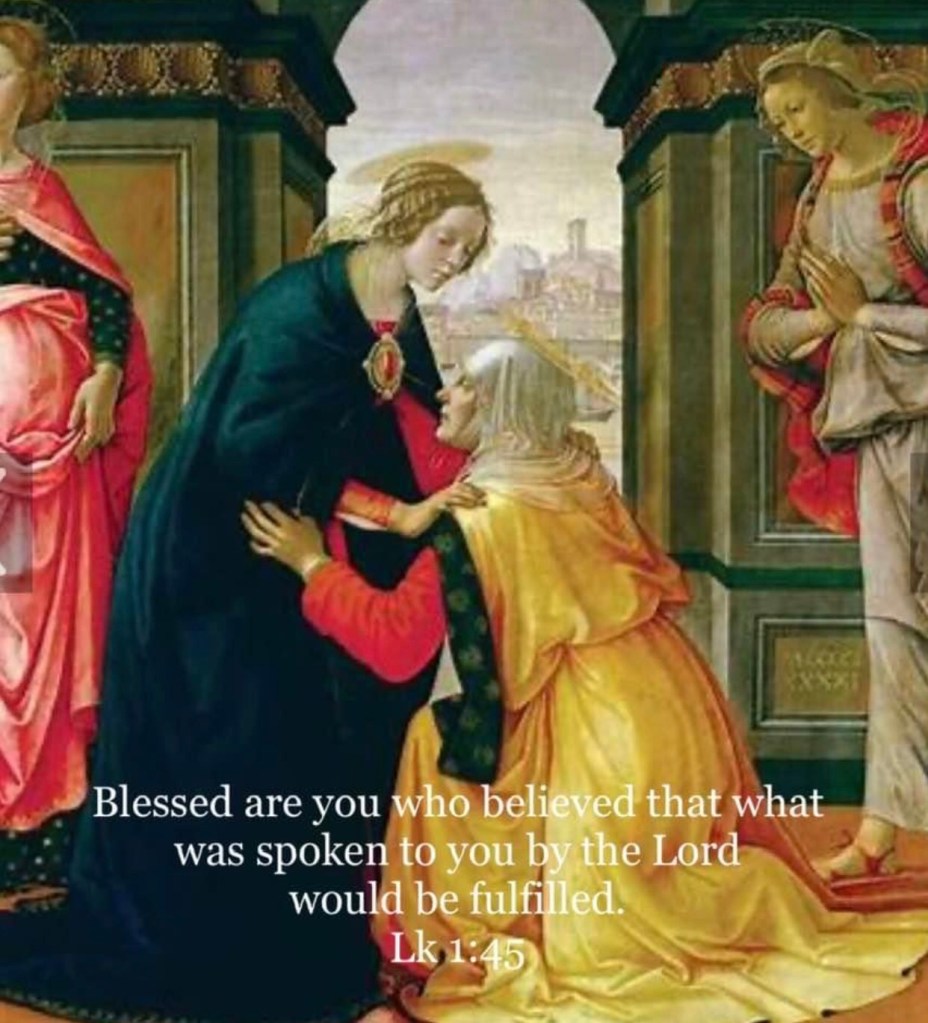
Last week, during the final days of Advent, we read one of my favorite scripture passages, Luke 1:39-45: The Visitation. In a series of verses just preceding this one, Gabriel announces it is Mary who has been chosen by God to bear the Christ and that her cousin, Elizabeth, despite her “old age,” is also expecting a baby (John the Baptist). Filled with the Holy Spirit, Mary “set out…in haste” (Lk 1:39); she ran (because the Holy Spirit is a Being of action and movement) to her cousin, literally to share the Lord with her and assist during the last months of her pregnancy.

When Mary arrives, Elizabeth, also filled with the Holy Spirit, immediately acknowledges her as the Blessed Mother and rejoices that “the mother of my Lord should come to me.” This is a joy-filled encounter of mutual recognition and thanksgiving. What’s more, Elizabeth not only hails Mary as the Mother of God, she also praises and blesses her for being open to and trusting Him, for it is only through Mary’s faith and fiat that God’s will is accomplished. Elizabeth rightly proclaims that Mary is blessed in her spiritual motherhood. Just as important, though, her fullness of grace is realized because she first “believed that what was spoken to [her] by the Lord would be fulfilled.” It is Mary’s faith and openness to God that leads to the fulfillment of our salvation.

We have made our way through Advent, filled with quiet and patient waiting for Jesus’s coming. Now celebrating the Christmas Octave, may we reflect on the glory and hope of Christ’s birth and remember the encounter of these faithful cousins. Open to God’s love and willing to trust and believe in His goodness, may they inspire us to repeatedly order ourselves to Him so as to fully participate in His salvific love.

What the Canaanite Woman Teaches Us

And Jesus went away from there and withdrew to the district of Tyre and Si’don. And behold, a Canaanite woman from that region came out and cried, “Have mercy on me, O Lord, Son of David; my daughter is severely possessed by a demon. But he did not answer her a word. And his disciples came and begged him, saying, “Send her away, for she is crying after us.” He answered, “I was sent only to the lost sheep of the house of Israel.” But she came and knelt before him, saying, “Lord, help me.” And he answered, “It is not fair to take the children’s bread and throw it to the dogs.” She said, “Yes, Lord, yet even the dogs eat the crumbs that fall from their masters’ table.” Then Jesus answered her, “O woman, great is your faith! Let it be done for you as you desire.” And her daughter was healed instantly (Matt 15:21-28).

Today’s reading is so rich, we can approach it from a myriad angles. This is a passage about how Jesus teaches us; about the perseverance of faith; about healing; about the Lord eventually spreading his Word to all peoples. In addition, because of some recent thoughts I bring to today’s reading, I am particularly focused on what this passage shows us about a mother’s love for and devotion to her child.

Today motherhood, indeed womanhood itself, is under attack. Childhood, for that matter, is prey to those who seek to destroy innocence as well. I cannot shake what I saw this week in the news. Health Secretary Rachel Levine praised an Alaska gender-affirming “care” clinic, seeking to replace the term “mother” with “egg producer,” “carrier,” “gestational parent,” or “birth parent,” and the word “men” with “XY individuals.” This facility also argues that the term “gender reveal party” be replaced with “embryogenesis parties” or “chromosome reveal parties” (https://www.dailymail.co.uk/news/article-12413023/Bidens-trans-health-secretary-Dr-Rachel-Levine-praises-Alaska-gender-affirming-care-clinic-wants-word-mother-replaced-phrase-EGG-PRODUCER.html).

What does this insanity have to do with today’s Gospel? If we are to return to the reality of who we are in Christ, we must be able to clearly see the culture for what it is, filled with chaos and lies, and then reject it, pointing instead to what is good, true, virtuous. It is tempting to reject the culture as ridiculous and unworthy of attention given these absurd arguments. But we would be naive and irresponsible to do so. Among the many terrible consequences of such language, perhaps the worst is that it is designed to dehumanize that human person. “Egg producer,” “carrier,” etc. are not only terms meant to foster a gender neutral society devoid of male and female, they are also distinctly utilitarian terms. They reduce the human being, in this case the woman, to nothing more than a flesh factory useful for and defined by her parts. (Pretty ironic given that the proponents of this ideology seek to persecute those who praise women for their physical attributes.)

To return to the Gospel, what is scripture teaching us about such matters? Here is a woman–not a birthing person, not a carrier–who is risking everything to help her child. She has left the comfort of her home and her people. In her desperate attempt to attract Jesus, the apostles become irritated with her and desire to send her away. Jesus, too, shows uncharacteristic indifference to her, likening her to dogs–Gentiles not yet worthy of His conversion. But there is more at work here. Jesus shows us time and again that our first interpretation is probably not the whole or even correct one.

Indeed, Jesus is not willfully uncaring or apathetic here. He recognizes this woman’s need from the beginning. Rather than a sign of indifference, Jesus’s silence, nay His seeming rejection, is actually an expression of love–a means of teaching her and refining her faith. Knowing her devotion to her child, He is testing and provoking her, and she responds by persevering and meeting the Lord where he seeks to take her. The Canaanite woman represents the heart of a mother who is willing to be humbled before God for the sake of her child. This is only the second example of Jesus healing from a distance, and it is the mother’s faith and her relationship with God that inspires it. Jesus teaches us through her example.

This passage exhorts us to ask, What do we believe about the virtue of life and motherhood? Are we glib and relativistic about it? Are we lazy about today’s language, shrugging it off as simply nonsensical and unimportant? Or in our desire to develop our relationship with Jesus, are we willing to become humble, express our vulnerability to God, and risk everything in an attempt to open our hearts, grow in our faith, and petition for the needs of others?

In today’s Morning Offering, Father Kirby likens the Canaanite woman to us as we journey in our “discipleship.” He explains:

The Lord Jesus…wants to teach us, guide us, take us deeper and deeper into what it is to love. He wants to refine our faith to such an extent that we know that we just have to be with Him. If He listens to us and grants our requests, if He makes things easy or difficult, if He blesses us with health and wealth or poverty and illness, that we will be with Him. The call of Christian discipleship is to be with the Lord Jesus, to be in His presence, to be His friend. St. Teresa of Avila says it best: ‘We worship the God of consolations, not the consolations of God.’ The Lord Jesus seeks to refine our faith–to draw us deeper and deeper into what it means to believe in Him, to be with Him….(https://www.goodcatholic.com/podcasts/morning-offering-with-fr-kirby/).

May we continue to learn from scripture how to be in the world–a world full of struggle and pain and difficulty, but one that also inspires us to return to what is true. The Canaanite woman shows us what it is to humble ourselves before the God who knows our hearts and seeks to heal us in all things. Let us pray that we might have her courage and be examples of true womanhood and motherhood for the sake of our children and the salvation of our souls.

The Relationship Between Love and Faith

At a time when many are arguing about love, perhaps it’s worth considering this virtue in a slightly different way. We are told we need to “love ourselves”; we should be allowed to love whomever and whatever we want in whatever way we want. We are told authentic love is all that matters and that each of us gets to decide what that means. But the chaos in our culture and the fact that society seems indeed bereft of love suggest that somehow we’ve drifted off course.

It’s hardly surprising that the body politic is perpetually confused about love. As we attempt increasingly to remove God from American life, we have also relegated faith to a system of silly beliefs and mythical fallacies. Who needs faith when we have facts? Well, the reality that many are suffering from a misunderstanding and lack of both love and faith suggests that each is essential to the other. Only in their reintegration, in fact, will the individual and the polity begin to flourish as they are called to do.

In his autobiographical work, He Leadeth Me, Father Walter J. Ciszek, S.J. (1973) offers us valuable insight about the relationship between faith and love:


Faith…is the basis for love; it is in the insight of faith that we understand the fatherhood of God and the brotherhood of all men. Love, Saint John writes repeatedly, is the one thing that fulfills all the commandments and the law. But prior to love, and bolstering it at the core, is faith; we must have faith before we can love, or we will surely end up loving the wrong thing–loving ourselves more than God, or loving creatures for themselves–and this is the meaning of sin. To increase our love, to love properly, we must strive always to increase our faith, and we do this by means of prayer and the sacraments (p. 192).

Without faith, Ciszek tells us, we will ultimately love in a disordered way; we will love wrongly. We know that as a society we are more anxious, sad, and depressed than ever. In this state we cannot love fully. No matter how hard we try, if we insist in fulfilling our desires and finding our loves in the material world alone, we will never truly love.

“A man of faith is always conscious of God,” Ciszek (1973) tells us, which is to say he is always aware of perfect goodness, perfect love (p. 192). May we contemplate the importance of faith in our own lives, and in so doing, reorder ourselves to love as Christ calls us to do.

Ciszek, W.J. (1973). He Leadeth Me. Image.

Called to Humility

The Catechism tells us, “‘Prayer is the raising of one’s mind and heart to God or the requesting of good things from God.’ But when we pray, do we speak from the height of our pride and will, or ‘out of the depths’ of a humble and contrite heart? He who humbles himself will be exalted; humility is the foundation of prayer. Only when we humbly acknowledge that ‘we do not know how to pray as we ought,’ are we ready to receive freely the gift of prayer. ‘Man is a beggar before God'” (CCC 2559).

If we are called to humility in prayer, Micah’s words speak to how we are to “be” in the world. Yes, we carry our prayers with us throughout the day. We are called to “pray without ceasing” (1 Thessalonians 5:17). But notice how Micah addresses us as “mortals.” As “good” people, what is “required” of us in the world? Who are we called to be with each other? After all, Jesus desires to have a “real” relationship with us, and it is this union that is meant to inform all of our other relationships. We care called to “act,” “love,” and “walk”–all physical, real life experiences, imbued with the virtues of justice, mercy, and humility.

And who is at the center of this very being? This mortal experience? God, of course, “For in Him we live, and move, and have our being” (Acts 17:28).

Do You Know Who You Are? Some Initial Thoughts on the Theology of the Body

Do you know who you are? No, I’m not asking your name, what you do for a living, or if you play a sport. I’m asking, Do you actually KNOW WHO YOU ARE?

Today we are told our identities are fluid, changeable. We are told our sex is not only “assigned” at birth, but also that our sex (the physical bodily expression of maleness or femaleness) is only a servant to our more “important” gender–how we self-express and see ourselves in society. In other words, we are told our gender (how we self-express) is to comply with how we feel, rather than aligning how we feel (which can change depending on our state of mind or mood) with the reality of the body, which is our “sex.”

At the root of all of this confusion is our disrupted relationship with God and with the Holy Spirit who lovingly calls us into right order with Him. As our culture increasingly rejects Him, we become more confused and willing to accept the dystopia and dysphoria that result from this separation. As Gaudium et Spes declared, “When God is forgotten, the creature itself grows unintelligible” (36). Commenting on this idea, Jason Evert explains in Ascension’s course on Theology of the Body, “When we lose sight of supernatural realities, we will lose sight of natural realities” (Segment 2, Session 1). Indeed, we have lost sight of the reality of who we are, not only physically (we reject our very bodies), but also spiritually–who we are in God.

Here are some additional excerpts to ponder from Jason’s presentation:

“Our bodies reveal not only our identity as male and female, but also our calling.” Who we are is determined by our bodies, and it is this identity that calls us into relationship with one another in a unique and ordered way. When we don’t know who we are as male and female, our relationships with ourselves and each other become disordered.

“Men and women make the invisible love of God visible on earth by the way we love.” Although God is invisible, He is made visible, made manifest, through our very bodies and the way we love one another. We are called to reflect the perfect love of the Trinity. God’s relationship with the Son is expressed through the Holy Spirit, who is the unending and ever-moving love between them.

Today we are encouraged to identify with our concupiscence; we are encouraged to declare, “God made me this way, so I’m fine as I am.” But this is not who we really are. “If I come to think that my brokenness is who I am and who God wants me to be, then I’m normalizing my brokenness. And we will assume the Church is out of touch with reality if it expects us to live differently.” But JP II has a different vision. He declares that “our brokenness is not who God created us to be…These vices do not [constitute] our identities. We are not the sum of our weaknesses and failures.”

What is your identity? How are you defining it? Do you know who you are?

We are the Woman of Tyre

Jesus went to the district of Tyre. He entered a house and wanted no one to know about it, but he could not escape notice. Soon a woman whose daughter had an unclean spirit heard about him. She came and fell at his feet. The woman was a Greek, a Syrophoenician by birth, and she begged him to drive the demon out of her daughter. He said to her, “Let the children be fed first. For it is not right to take the food of the children and throw it to the dogs.” She replied and said to him, “Lord, even the dogs under the table eat the children’s scraps.” Then he said to her, “For saying this, you may go. The demon has gone out of your daughter.” When the woman went home, she found the child lying in bed and the demon gone (Mark 7:24-30).

When I read this Gospel early yesterday morning (2/9/23), it immediately resonated with me in a deep way, and I smiled to myself, understanding that God was speaking to my heart. 

Here is the Lord, wanting some time away from the crowds during His full days of ministering to them. In His humanity, we can imagine He is tired; He has been talking and healing for hours. But alas, this is not to be. A woman, a Gentile, no less, has found Jesus, followed Him into the house, and then falls “at His feet.” 

At first, He is noticeably a little irritated (although probably just responding in a clarifying manner) and tries to dismiss her. Jesus makes a comment about children and dogs, which scholars have argued has a variety of meanings, but ultimately suggests that He is at least appearing to be reluctant to help her. The woman, however, understanding His meaning, persists. Her love for her daughter is so great, her willingness to confront the Lord is so courageous and faithful, that Jesus cannot deny her. Even in this brief encounter, she and Jesus have formed a relationship—one of trust and love and faith. Jesus bears witness to the woman’s very real vulnerability, understands and hears her, and because of this frees her daughter from sin. 

How many times have we suffered for our children? How many hours have we worried, sought answers, and committed ourselves to doing anything we can to alleviate their suffering, pain, and struggle? How many late nights and early mornings have we sat in prayer, asking the Lord to deliver them? 

This mother in this story represents every one of us who has found the courage to become righteous warriors for our children—every one of us who is willing to go to the Lord, pleading for His merciful goodness and healing. It is not enough, however, just to ask for God’s help. Like this woman, we must remain determined to seek Him, follow Him, and then speak to Him with hearts fully open to His love. We cannot do this haphazardly. We cannot neglect Jesus for long periods of time and then only go to Him when we’re desperate. Of course, God can attend to us at any time. Even when we’ve been away from Him for a while, we can experience the healing of actual grace. But what this mother shows us is that when we are in relationship with Christ, when we are determined to find Him, be near Him, and ask for His understanding and help, He will always answer us. 

Although in this story Jesus was seeking time away from the crowds, He actually wants us to look for and find Him. In fact it is our very suffering that serves to draw us close to Him. He knows this, which is why, when we call for Him in our pain, He is there to comfort and heal us. 

At a time in our culture when women and mothers are often undermined and questioned, and when we sometimes ask ourselves if we have the courage to help our children through their sufferings, let this woman assure us we are in fact capable of doing just that. We cannot do it alone, however. As we cultivate our relationship with God, as we sit at the foot of the cross and integrate our pain with Jesus’s sacrifice, we are then in a position to best serve, care for, and lead our children. 

Mirroring the humility and faith of this woman and of course, Our Lady, may we continue to seek God’s love and goodness. May we pursue Him with courage and fierceness. And may we know when He answers us that it is our faith, born out of the crucible of suffering, that has saved us.