
Matt 10:17-22
“Beware of men, for they will hand you over to courts and scourge you in their synagogues, and you will be led before governors and kings for my sake as a witness before them and the pagans. When they hand you over, do not worry about how you are to speak or what you are to say. You will be given at that moment what you are to say. For it will not be you who speak but the Spirit of your Father speaking through you. Brother will hand over brother to death, and the father his child; children will rise up against parents and have them put to death. You will be hated by all because of my name, but whoever endures to the end will be saved.” (Matthew 10:17-22)
Wasn’t yesterday Christmas Day? Weren’t we just hours ago reveling in the beauty of Mass, excitedly visiting the manger scene lovingly arranged on the altar, singing Silent Night, Joy to the World, and the Hallelujah chorus along with the choir? We were celebrating the birth of our Savior, finally illuminating this dark world with the brightness of His hope and love and promise of salvation?
And today Matthew tells us to “beware of men” who will hand us over to be persecuted. He speaks of families turning against each other and how much we will be “hated” because of our faith. We are not given much time to rest in the joy of Christmas Day; scripture jolts us right back into reality–into what is to come because Christ is born.
And yet, Matthew reveals to us at the end of this passage that “whoever endures to the end will be saved.” In her wisdom, the Church presents us with this reading on the second day of the Christmas octave, precisely because she is reminding us, foretelling us, of the grand scale of Jesus’s birth and life. It is His light, at once celebratory and joy-filled, that is also providential of the suffering and the Revelation yet to come.
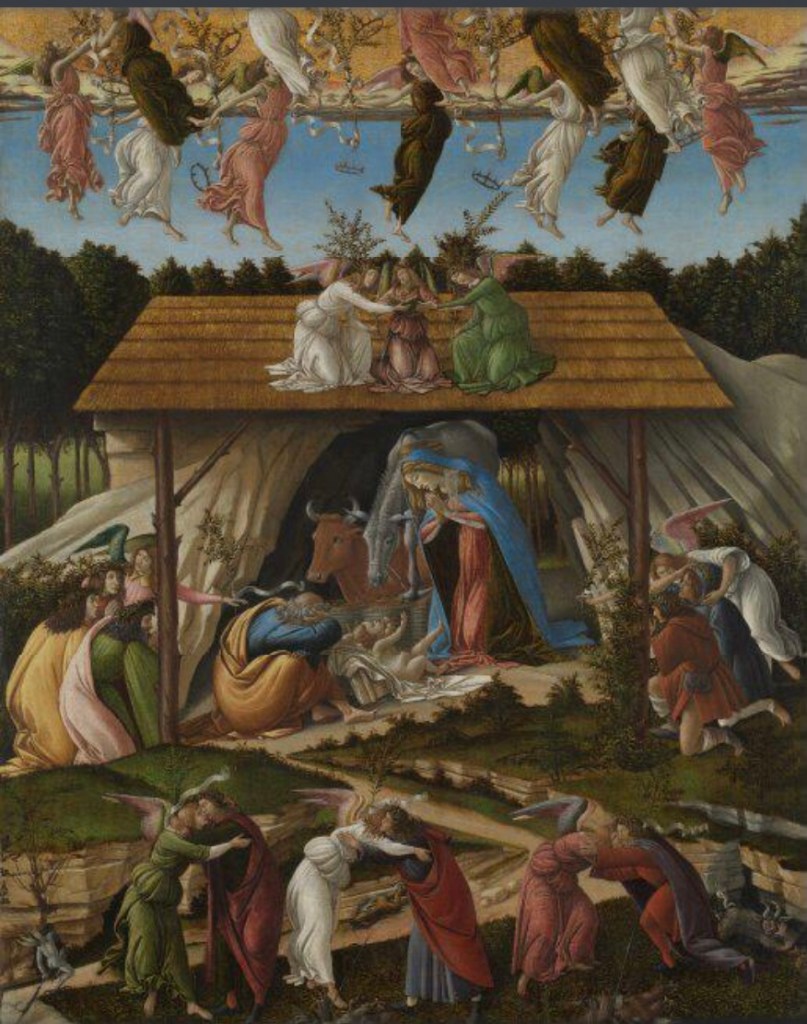
Botticelli’s Mystic Nativity in the National Gallery of Art in London assists us in comprehending this message. In his shockingly stunning rendering of the Nativity, he includes other elements we usually do not see. Angels sing on the roof of the makeshift cave/stable, others hover over the Holy Family, carrying crowns and banners and flowers, and still others direct kneeling visitors to look towards the Christ child. At the bottom quarter of the painting, however, among the angels greeting pagans (who have now come to worship), we see demons creeping among the grass, some being pierced by these same angels and cast out of this scene to the underworld.
Botticelli’s Nativity, in fact, reminds us of Matthew’s Gospel. At the birth of Christ, we are not only to rejoice at Jesus’s coming, but we are also to be mindful of the fullness of the salvific prophecy that the prophets foretold. For it is at the Nativity that we now see and understand more concretely that good and evil will war against each other. That truth and falsehood will be at odds. That God and the anti-Christ will battle, and men will rage against one another.
Botticelli’s painting, however, parallels our belief, reminding us that, despite the demons lurking in our midst, God will be victorious. Here, the grandest and most significant figures, arranged right in the center of the composition, are Mary, angelic and statuesque, and the Christ child over whom she kneels and prays reverently.
Matthew tells us that we “will be saved” if only we endure to the end–to the end of Christ’s life, to the end of time. Let us not be afraid. Let us, rather, like Our Lady, remain focused on God who is always in our midst and firm in our faith–in all that is good and true. Let us hold fast to the salvation that the Christ child initiates, and that we continue to celebrate, at Christmas.
 To Live Gladly